
Benefits help small communities thrive
It stabilizes local economies, especially rural ones

Social Security distributes over $1.6 trillion in benefits each year, aiding nearly 69 million Americans every month. These benefits don’t sit idle in a savings account — they circulate in our local communities as they are spent for food, medical bills, gas and rent.
Those benefits you spend are a welcome injection of cash in your local economy, and especially in rural areas where more older people live and wages are lower. They help support employment in local businesses and help communities stay vital.
A huge factor in Minnesota, especially in rural areas
In Minnesota, about $26 billion in benefits are paid annually. That’s equivalent to the total value of the state’s livestock and crop production. This figure is also roughly comparable to the construction industry’s GDP and much larger than the state’s tourism industry, which brings in $15 billion .
The income generated from Social Security is a steady source of income for local businesses, that shows a consistent trend of growth regardless how the rest of the sectors of the economy perform.
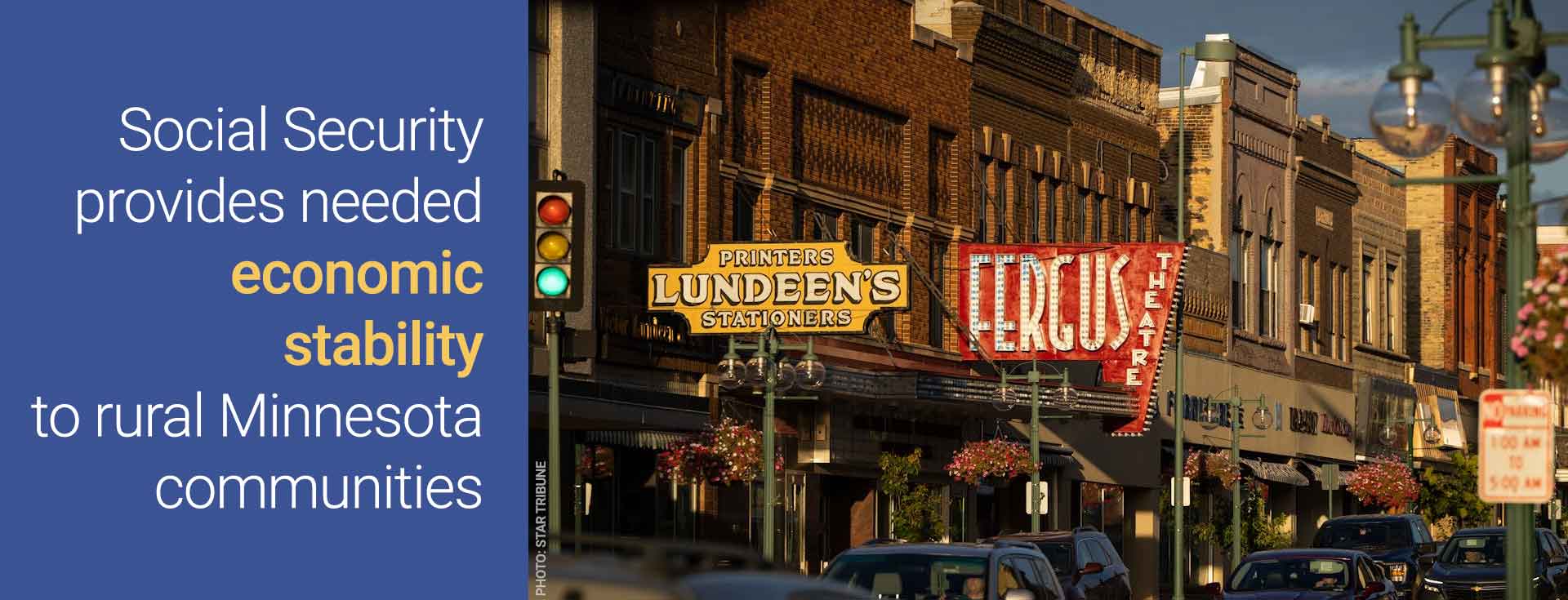
The economic influence of Social Security is particularly significant in rural areas, where 85 percent of businesses are small, family-owned enterprises. These main street businesses keep many rural communities vibrant. Those businesses are helped considerably from the reliable influx of Social Security benefits, as they are more exposed to the risks that climate change can bring to agriculture and tourism.
Minnesota’s four predominantly rural congressional districts have a higher number of older people and disabled people compared to the metro districts.
View the benefit totals in your area
Minnesota’s eighth congressional district (CD8) depends on Social Security benefits more than any other district. It brings in nearly $355 million in benefits monthly. It’s followed CD7 with $317 million. By contrast, the mostly urban district, CD5, is least dependent with $196 million in monthly income.
The above figures are as of December 2024 and are likely higher today. The Social Security Administration will publish a 2025 congressional district update in July, 2026.
You can also view Minnesota data at the county level. Note that the dollar amounts are displayed in “thousands” of dollars. Therefore, remember to add three zeros to the numbers you see.