
Wait, isn’t Social Security going broke?!?
No, but new funding is necessary to avoid benefit cuts

Social Security is not going to be “broke” in the way most people perceive that term. However, the trust fund’s surplus is projected to be depleted by 2023, as indicated by the latest report from the Social Security Administration.
The trust fund nearly ran dry before
Throughout its 91-year history, Social Security has experienced multiple revisions. The most recent adjustment occurred in 1983 when, much like the current situation, the surplus of the fund was in jeopardy of running out.
Congress addressed the issue with a variety of changes. The most significant alterations included raising the full retirement age to 67, expediting payroll tax increases, imposing federal income tax on up to 50 percent of benefits for high-income earners, and broadening coverage to include new federal employees.
Initial projections suggested that these modifications would ensure Social Security’s solvency until 2060. However, the most recent forecasts indicate that the surplus will be exhausted by 2034.
According to the Brookings Institution, the magnitude of the challenge is now twice what it was in 1983. Moreover, the longer Congress postpones action, the more difficult the situation will become.
What shifted from FDR to Reagan?
From the end of World War II until the 1970s, American income was distributed more equitably than it has been in recent decades. This period is often regarded as one of widespread prosperity, where economic growth raised incomes at a relatively uniform rate across all levels.
The election of President Ronald Reagan in 1980 ushered in the era of “trickle-down economics.” This approach involved substantial tax cuts for the wealthy and corporations, deregulation, and a reduction in social spending.
Reagan promoted the notion that tax cuts for the affluent would ultimately benefit everyone else. In reality, the opposite happened.
Despite the evidence that huge tax breaks for the affluent made inequity worse, the George W. Bush and Trump Administrations doubled down on them.
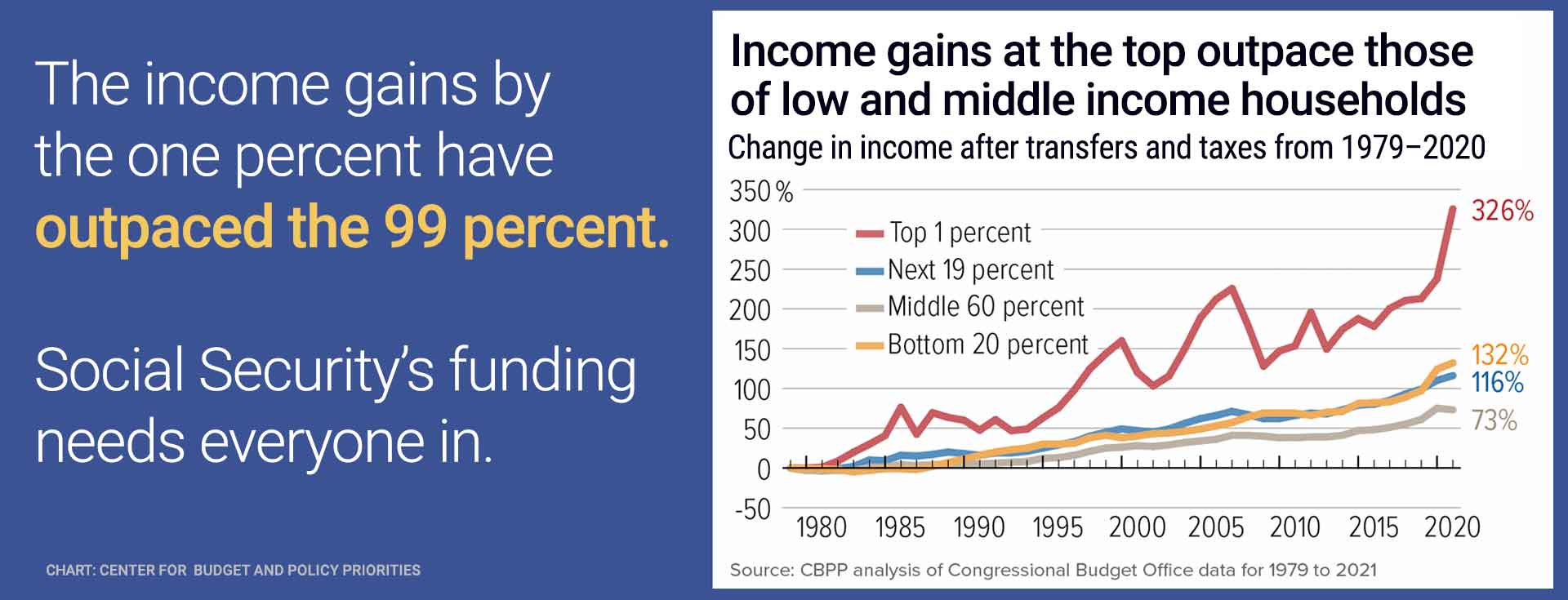
The elephant in the room: massive wealth inequality
In the initial years of Social Security, there were forty contributors for every person receiving benefits. Today, that ratio has plummeted to less than three-to-one.
The wealthiest one percent of households now control 32 percent of all wealth in the U.S. Their financial resources are approximately equal to the combined wealth of the bottom 90 percent of Americans!
Income inequality has reached unprecedented levels, reminiscent of the Gilded Age in the 1920s, a period that ultimately triggered the Great Depression. This disparity prompted FDR to establish Social Security, and the current situation compels us to reevaluate our approach to funding this essential program in the future.
Congress needs to find an equitable solution
The prosperity of America has been constructed upon the hard work of its labor force. It is imperative that every American contributes to the funding of Social Security, including those who have benefited the most from the wealth generated by our system.
That sentiment is shared by some of the one percent, too.
The Patriotic Millionaires* is an organization consisting of 118 members who are striving to reform the tax code that permits individuals like them to pay a significantly lower effective tax rate than firefighters and other millionaires. This is essential reading.