
Social Security insures your income
Understand how it protects you in retirement, disability and death

Social Security protects you and your family during all of your working years, and will be there for you when you most need it. If you retire, or become disabled it will replace much of your income, allowing you and your family to afford the things you need to live a good life.
It’s even there for your spouse and minor children, should you pass away prematurely.
It is the backbone of America’s social safety net. No other government program reaches as many people and provides millions of working families with reassurance. In its 91-year history, it’s paid out $26.5 trillion in benefits – and has never bounced a check!
Social Security is your income insurance policy
The official title of Social Security is Old Age Survivors and Disability Insurance (OASDI). It acts as insurance to compensate for lost income due to death, disability, or aging.
Eighty percent of Social Security recipients are retirees, twelve percent are individuals with disabilities, and eight percent are surviving family members of deceased workers.
We strongly recommend visiting the Social Security Administration (SSA) website to set up your personal account. This will display the actual benefit amounts you are entitled to, along with much more information.

Social Security provides you income in retirement
To be eligible for retirement benefits, you need to work for at least ten years and pay Social Security taxes, which are mandatory and deducted from your paycheck.
Full Retirement: typically at age 67.
Early Retirement: you can start receiving benefits at age 62, but this will lower your monthly benefit by as much as 30 percent.
Delayed Retirement: you have the option to postpone your benefits. For every month you delay taking benefits between ages 67 and 70, your monthly benefit will increase. This can result in an additional 28 percent added to your monthly benefit payment.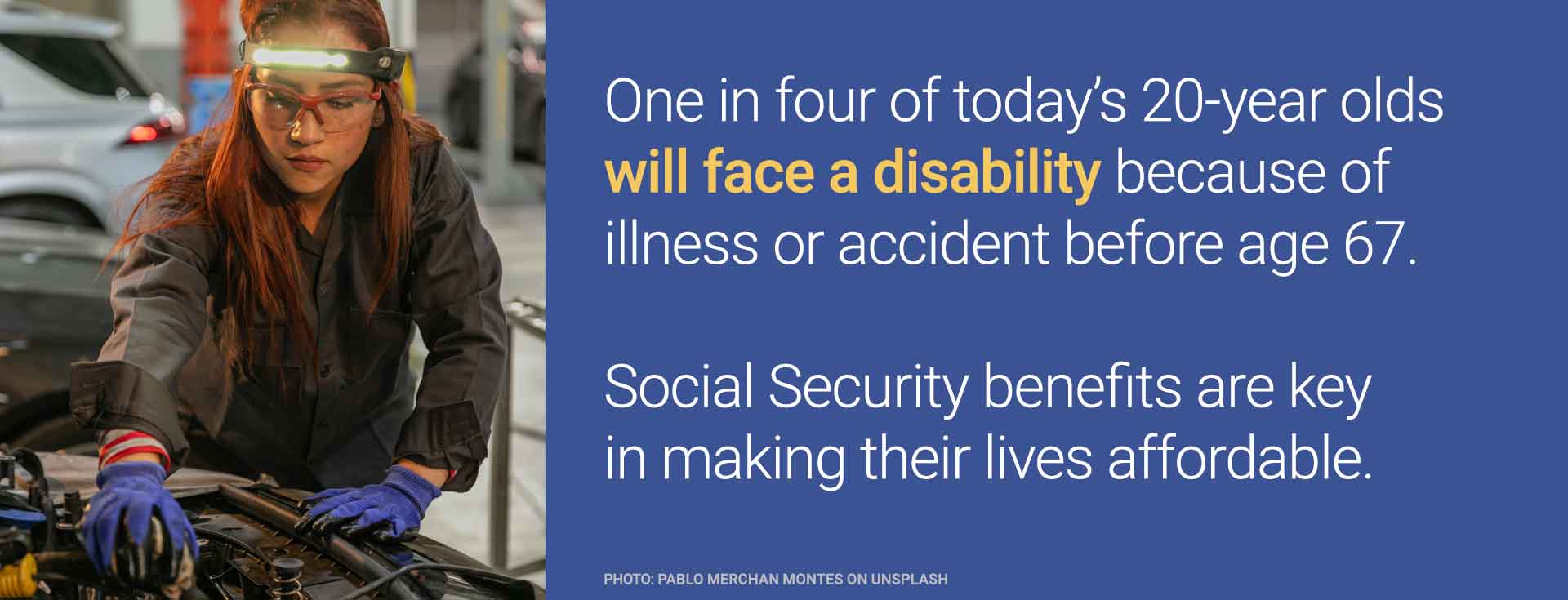
Income protection if you become disabled
Here’s a concerning statistic. The SSA reports that one in four of today’s 20-year-olds will face a disability before they turn 67. This could be due to an illness or an accident that qualifies them for disability benefits.
Approximately 11 million disabled Americans depend on Social Security benefits to survive. Most are unable to work because of their disability or can only work limited hours.
You will be eligible if you have a disability or blindness that hinders your ability to work for over a year, or one that could lead to your death.
In general, you must have worked for at least five of the last ten years to be eligible. However, if you are under 24, you might qualify with fewer credits.
If you have a disability but can still work, your benefits may be revoked if you earn more than what is known as “substantial gainful activity” (SGA). In 2026, SGA is set at $1,690 per month, or in some cases, $2,830 for certain cases of blindness.
If you are disabled and receive Social Security benefits, your family members might also be eligible for family benefits; refer to this fact sheet for more information on eligibility.

Income for your family if you die
Social Security survivor benefits can offer monthly payments to your spouse(s), children, or dependent parents after your passing. These benefits depend on your earnings record.
Spouses: your surviving spouse can receive the full benefit amount when they reach their full retirement age. Alternatively, they can take a reduced amount starting at age 60, or as early as age 50 if they are disabled. If they are looking after your child who is under 16, they may qualify at any age.
Typically, you and your spouse must have been married for at least nine months to be eligible.
If you were married for over ten years and the marriage ended in divorce, your ex-spouse might qualify for benefits. However, if they remarried before turning 60, they will not be eligible for benefits.
Children: your unmarried children under 18 (or under 19 if they are still in high school) may qualify for benefits. Disabled children can access your benefits at any age.
If your parents survive you and were financially dependent on you for at least half of their support, they may be entitled to benefits. They must be 62 or older, have not remarried after your death, and not be eligible for a higher benefit based on their own work history.
How your Social Security protections are paid for
Social Security has three sources of income. The first is a specific payroll tax, and the second comes from the interest earned by Social Security investing its excess funds in government treasury bonds. The third source is from a federal income tax on the benefits of some high earning retirees. Congress created that tax in 1983, specifically to boost Social Security’s revenues.
It’s a frugally-managed program, 99.5 percent of its revenue is returned as benefits. Only half a percent goes towards administrative costs.
The amount you pay into Social Security can best be thought of as the premium for the insurance it provides to your paycheck. The deduction is shown as FICA (Federal Insurance Contributions Act).
FICA covers Social Security (6.2% from both employer and employee) and Medicare (1.45% from both). If you are self-employed, you are responsible for both the employer and employee contributions.
The Social Security part has a limit, meaning the tax applies only to the first $184,500 you earn in a year (it’s also referred to as a “cap”). The Medicare portion does not have a limit.